Nvidia’s CEO Return Raises Governance Questions as AI Markets Reprice Risk
Jensen Huang is back at Nvidia, but succession concerns and scrutiny of chip sales weigh on the story as AI spending and tech valuations diverge.
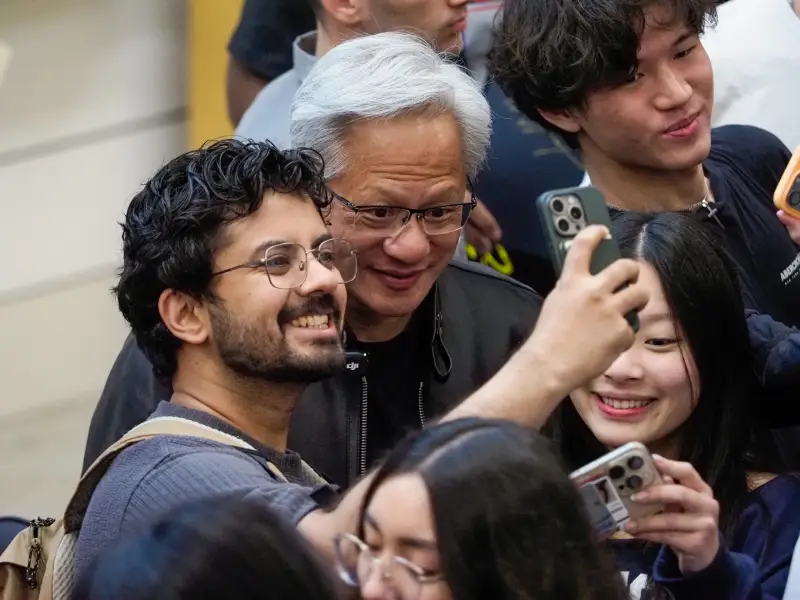
Jensen Huang’s return to Nvidia puts leadership continuity and board oversight at the center of a week that also exposed growing uncertainty around AI spending. The board reversed its decision to remove him as CEO, president and director. The move drew support from people concerned that his departure could unsettle the company and the wider AI market, but Nvidia’s succession planning and conduct remain under scrutiny.
Huang has built Nvidia into one of the world’s most valuable companies. That record makes the board’s decision understandable as a short-term effort to preserve stability. It also sharpens the longer-term question: what happens if the company’s most influential leader cannot serve? A succession plan is a basic part of board oversight, especially at a company whose products sit at the center of major AI infrastructure investments.
The reversal came amid continuing questions about Nvidia’s business relationships and chip shipments to China. Reports have linked associates of Huang to Chinese firms and raised questions about access to restricted Nvidia processors. Those issues are subject to continuing inquiries, and the details are still developing. For customers and technology teams, the practical concern is whether changes to chip availability or sales controls could affect procurement plans and the supply of high-performance hardware.
The market response offered a check on expectations that Huang’s return would lift AI-related shares. AI infrastructure stocks continued to slide during the week, while Anthropic closed higher. That divergence suggests investors are weighing individual companies and spending plans rather than treating AI exposure as a single trade. A familiar leader may reassure some investors, but it cannot resolve questions about demand, supply constraints or the returns from large-scale infrastructure spending.
Enterprise AI shifts toward fit and cost control
Open-weight models are gaining traction with companies that want more control over how AI systems are adapted and deployed. Paul Gillin described the shift as a move from experimentation toward more disciplined financial and architectural management. His central point is that model size and benchmark rankings matter less than matching a model to the task.
For IT leaders, that changes the evaluation conversation. Teams may need to weigh customization, operating costs and infrastructure requirements alongside a model’s headline capabilities. An open-weight approach can offer flexibility, but the source provides no comparative cost or performance figures. The useful takeaway is to assess models against real workloads and deployment constraints rather than assume that the largest model is the best fit.
AI also continues to shape expectations around cybersecurity. The week brought major consolidation news: CrowdStrike agreed to acquire Zscaler in a deal valued at about $44 billion, following Palo Alto Networks’ $4.5 billion plan to acquire Applied Compute the previous week. The deals point to pressure on a security market built from many separate products. As AI makes attacks easier to generate and more numerous, buyers may favor broader platforms, though consolidation alone does not establish how well products will work together.
Strong results do not guarantee a share-price lift
Recent company results showed how uneven investor reactions have become. Dell more than doubled its revenue, yet its shares went nowhere on Wednesday. HP faced a slowdown in the PC market, but its shares rose more than 12%. HPE’s stock fell despite record revenue growth and an upbeat forecast.
Those moves suggest that results are being judged against more than headline growth. Investors are also assessing the durability of demand, the effects of AI investment and the outlook for established hardware businesses. For technology suppliers and their customers, that mix can make market expectations hard to read: one strong quarter may not settle questions about what comes next.
The wider week’s coverage included developments across enterprise software, AI companies, infrastructure and security. SAP reportedly planned to cut more than 10,000 jobs amid its AI push, while Nutanix CEO Rajiv Ramaswami was set to step down as the company began looking for a successor. Amazon Web Services appointed Muralidhar Krishnaprasad as vice president of data, storage and analytics after eight years at Salesforce, where he most recently served as president and chief technology officer.
Other reported moves included Amazon’s acquisition of key assets from AI startup Decart, Sierra closing a $1.75 billion investment, and Anthropic’s stock falling below an $83 IPO price. ElevenLabs was reportedly seeking funding at a $33 billion valuation. New AI companies and financing rounds included Epochal AI, Zipher, AidenAi, Aevius Labs and Verra. These announcements show continued capital and product activity across AI, but they do not by themselves establish which companies will achieve lasting adoption.
Infrastructure and security remain active areas
Several announcements focused on tools and infrastructure for AI deployment. Anthropic introduced Claude Ship to automate a later stage of software development and explored generating desktop applications with Claude. AWS updated its Strands framework for AI agents. Cloudera introduced a digital sovereignty platform spanning AI and infrastructure, while Miren launched an application deployment platform.
Security coverage raised a practical concern for organizations adopting agents: authorized access does not guarantee safe behavior. One report found that AI agents leaked confidential data in 87 of 100 test runs. That result is attributed to Cyberhaven’s testing; the source provides no further test conditions here, so it should not be treated as a universal measure of agent behavior. It does, however, underline why teams should check what information agents can access and what actions they can take.
Other security developments included Cisco and OpenAI launching the open-source Shirudo infrastructure shield, and Exein introducing an agent to help manufacturers prioritize firmware weaknesses. Separate reporting described a Microsoft 365 outage that lasted nearly 24 hours, along with incidents involving a customer-records exposure at 1Password and exposed log collectors. These items reinforce that operational resilience depends on identity controls, monitoring and dependable service recovery as well as new AI defenses.
Infrastructure investment extended beyond the largest cloud providers. Marlowe raised $277 million to build inference clusters using chips from Nvidia rivals, and wireless networking chip startup Altair secured $100 million. Myriota raised $40 million to expand its industrial Internet of Things satellite platform. Other announcements covered post-quantum cryptography, robotics components and data security.
Next week’s calendar
AWS re:Invent runs Nov. 30–Dec. 4 in Las Vegas, where AWS typically introduces many new services. The event is the week’s main product-watch item for cloud teams. Administrators should track announcements for changes that could affect their service plans, architecture or existing workloads, then review specific release details before making operational decisions.
Company results are also due from Salesforce, Snowflake, UiPath, Marvell, MongoDB, NetApp and Okta, among others. NetApp, MongoDB, Marvell, Okta, Box, Asana and GitLab are listed for Tuesday, Dec. 1; UiPath, SentinelOne, Samsara, PagerDuty and DocuSign are listed for Thursday, Dec. 3.
Nvidia’s leadership decision may settle an immediate question, but the company still faces scrutiny over succession, business relationships and chip access. For IT leaders, the clearest signal is to keep procurement assumptions and AI infrastructure plans tied to confirmed supply, product details and workload needs—not to confidence in any one executive or market narrative.