Sovereign AI Requires Workload-Level Controls and Ongoing Testing
Most surveyed buyers require local AI inference, yet many haven’t tested key revocation or disconnected operations. Map exposure and verify controls per workload.
AI sovereignty is an operating question as much as a data-location question: who can access the information, which model processes it, who runs the service, and what happens if a provider relationship changes? For organizations handling sensitive workloads, those decisions belong in the architecture review. A regional data center alone may not answer questions about jurisdiction, privileged support access, model endpoints, or exit costs.
A study of 11 senior technology decision-makers in regulated and critical-infrastructure organizations found a gap between buyers’ concerns and their evidence of control. Seven respondents said they had not tested disconnected operations, key revocation, or exit scenarios. Only four had deployed or piloted a dedicated sovereign offering. Cost and the work of operating another environment were the main reasons buyers added controls to platforms already in use.
That leaves a practical challenge for IT leaders: establish which controls a workload needs, then verify that those controls work under realistic conditions. Sovereignty needn’t be an all-or-nothing standard. Teams can accept different levels of exposure for different workloads, provided a business owner understands and accepts the risk.
Support access belongs in the architecture review
Data residency doesn’t settle every operational question. One European information technology and telecom buyer said that deep support escalations can, in some cases, involve personnel or systems outside the European Union, particularly when technical issues are difficult. That makes emergency procedures and privileged access part of the system design, not merely a support contract detail.
An organization may decide that outside access during an emergency is acceptable. The important step is to identify when it can happen, assess the consequences, and choose whether to add safeguards or accept the exposure. Those decisions should account for how access is granted, who can exercise it, and what evidence the provider supplies about its support processes.
Some organizations are waiting for more specific local requirements before expanding their sovereignty testing. In the meantime, many rely on existing privacy and cybersecurity practices. That uncertainty is a reason to define acceptance tests early: teams can document what they require from a system and revisit those checks as services and local expectations change.
Local inference can limit model choice
Nine of the 11 respondents said inference must stay within a sovereign or regional boundary. Yet buyers reported that model availability can lag in those environments. The tradeoff is direct: a locally available model may offer stronger control over where processing takes place, while a frontier service outside the boundary may perform better for a particular task.
For a sensitive workflow, teams can compare a self-hosted open-weight model with an approved frontier service. They’ll need to weigh the cost and quality of each option alongside the exposure created by sending prompts, retrieved information, outputs, or logs beyond the approved boundary. A Latin American financial-services buyer put the requirement plainly: if a request calls a U.S. endpoint, it doesn’t meet the organization’s boundary rule, whatever the contract says.
That kind of rule has to be checked across the full request path. A workload may begin in an approved environment but call another service during retrieval, inference, or logging. Teams should trace where data goes while the application runs and confirm which services touch it. The decision then becomes whether the business value of a model justifies the remaining exposure.
Jurisdiction and key ownership need separate checks
Seven respondents said that having a locally incorporated subsidiary does not, by itself, resolve their questions about jurisdiction. That is a buyer assessment, but it points to a gap technical reviews can’t close on their own. Legal analysis needs to examine corporate relationships and who actually controls the data and services.
For example, the U.S. CLOUD Act can require a provider subject to U.S. jurisdiction to produce data in its possession or control, regardless of where that data is stored. Customer-held encryption keys may limit outside access, but key ownership alone doesn’t establish legal immunity. It also creates an operational question: what stops working if the keys are revoked, and how will the service recover?
A South American bank executive described the absence of operational testing as the weakest point in the organization’s sovereignty story. The distinction matters: legal review can assess obligations and jurisdiction, while technical exercises show whether the organization can operate during disconnection, revoke access, or leave a service. Both kinds of evidence are needed.
Vendor scores are a starting point, not a selection rule
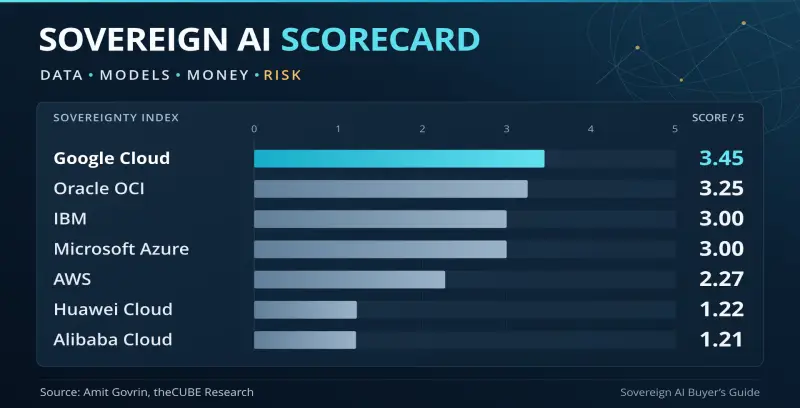
A point-in-time index revised Nov. 14 compared providers’ best live offerings across five buyer regions. Google LLC scored 3.45, Oracle Corp. 3.25, IBM Corp. and Microsoft Corp.’s Azure 3.0, AWS 2.7, and Huawei Technologies Co. Ltd. and Alibaba Group Holding Ltd. 1.2. The framework covered territorial, legal, operational, technical, and financial dimensions, using 17 yes-or-no tests across four nonlegal areas and a separate legal evaluation.
The scores reflect documented vendor claims and available controls; they don’t determine which provider will fit a particular workload. AWS may remain the practical choice for an organization that values its service quality or already depends on it. Azure, IBM, and Oracle can also suit customers because of existing deployments. AWS’s score was affected by the lack of a customer-run, air-gapped stack without vendor management. More broadly, the method rewards controls customers can exercise themselves, and missing documentation can lower a score.
Use a vendor comparison to narrow the evaluation, then check the exact offering available in the relevant territory against the workload’s requirements. A provider’s score can’t tell an IT team whether a specific support path, model endpoint, or recovery process meets its own risk threshold.
Test controls at the workload level
Start with a core business process. Map its data flows, dependencies, administrators, support paths, and model calls. Decide which controls it requires, who owns the risk, and what evidence will demonstrate that the system behaves as intended. For critical workloads, run those checks in a safe sandbox before production use.
Testing should cover privileged access, key revocation, recovery, and the ability to operate while disconnected if the workload requires it. Teams also need enough telemetry to see the route an AI request takes and verify what happened during execution. If the organization can’t observe those steps, it has limited proof that its architecture is enforcing its boundaries.
Include the financial and operational costs in the decision: ongoing operation, migration, staff retraining, the cost of exiting, and business disruption. Stronger controls may be justified for sensitive processes, while lower-risk activity can tolerate more exposure. The person accountable for the business process should accept the residual risk; IT should provide the evidence and explain the consequences.
Reassess when the system changes
Sovereignty needs ongoing attention because AI systems and their dependencies change. A model endpoint can move, a new model can become available, a service contract can change, or a new capability can enter production. Each change may alter who handles data, which jurisdiction applies, or what it costs to leave.
Make significant changes to models, services, and contracts a trigger for reassessment. Combine vendor documentation with technical tests, and record the exposure, the party with control, the accountable owner, and the risk the organization is accepting. For providers, clear control documentation, predictable operating costs, and evidence that supports their claims can help buyers make those decisions.
The practical measure of sovereignty is whether a team can show how a workload behaves, who can affect it, and what happens when a control is exercised. That evidence gives business owners a basis for choosing which exposures to accept and where stronger boundaries are worth the operating cost.


