coprod Raises $6 Million to Bring Modular Robotics Hardware to Market
coprod’s $6 million round will fund its EtherCAT-based component line and a Lausanne prototyping facility, with a full launch planned by the end of 2027.
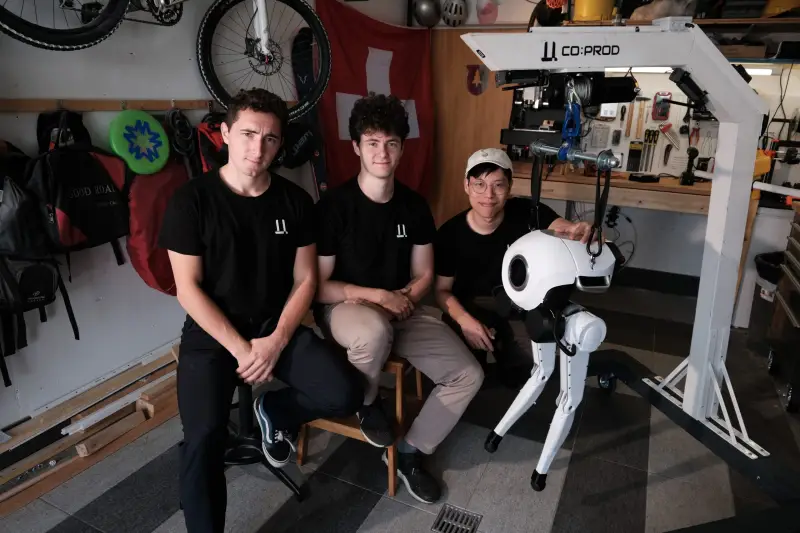
Robotics builders often spend years making components from different suppliers work together. Swiss startup coprod says its hardware and software stack can reduce that integration work to a few months. The company has raised $6 million to bring its first component line to market and build a prototyping facility in Lausanne.
Founded in 2024, coprod is developing compatible hardware for robots and physical artificial intelligence applications. Its approach pairs a shared control system with an application programming interface (API) and a configuration tool, with the aim of standardizing communication between components while maintaining the real-time performance needed by robot hardware.
One control plane for four component families
The core product, co:system, connects coprod’s modules through a single real-time EtherCAT control plane. It provides one API for C++ and Python. The planned component families are co:power, co:battery, co:sensor and co:motion. Each module can be used on its own or as part of a larger system.
That modular design targets a familiar engineering problem: suppliers support a range of communication protocols to serve different customers, but a collection of parts assembled from different vendors may not work together without custom integration. Coprod says the resulting electronics and software work can take two to three years before a robot system becomes reliable. The industry often calls that period “integration hell.”
The company estimates its stack could cut the effort to a small robotics team, $5,000 to $25,000 for each design iteration and a few months of work. Those figures are coprod’s claims; teams evaluating the platform will need to assess them against their own hardware, performance requirements and integration workload.
Co-founder and Chief Executive Loïc Delineau argues that robots built for specific tasks can outperform general-purpose machines on speed, cost and reliability, regardless of the model running on them. The company’s component strategy follows that view: standardize foundational hardware so robotics teams can concentrate on the systems and capabilities that differentiate their products.
Prototypes are already operating in Switzerland
Coprod says its components are powering several robots in Switzerland. One is XALUN, a humanoid built by the ETH Robotics Club. The student-built robot took its first steps in Zurich in recent weeks, according to the company’s account. Coprod is also working with robotics integrators and established labs to validate early hardware prototypes before a planned market launch early next year.
That validation period will matter to prospective customers. The company’s modularity and shared API are intended to simplify integration, but robot builders will still need to confirm that components meet the electrical, mechanical and real-time demands of their particular designs. Prototype testing can help establish how the parts behave in working systems before buyers commit to a broader deployment.
Lausanne facility aims to shorten development cycles
The funding will support a hardware prototyping workshop in Lausanne, equipped with CNC lathes, mills, lasers, and electronic assembly and testing equipment. Coprod expects the facility to reduce its development cycles from two weeks to 24 hours.
Testing there will also produce datasheets and digital twin models for each component. Digital twins can help engineers compare simulated behavior with results from physical hardware. Coprod is aiming to narrow that gap, which can complicate robotics development when software and mechanical designs behave differently in simulation and in the real world.
The company plans to have its full component line on the market, qualified and certified by the end of 2027. It expects large-scale production in Shenzhen and Texas, while keeping its headquarters and research and development in Switzerland. The stated timetable gives prospective customers a path to watch: early prototypes and partner validation first, followed by broader product availability and production capacity.
Supply constraints add pressure to component development
Access to components has become a constraint for robot makers, particularly in humanoid robotics. A McKinsey & Co. analysis published in April identified actuators and sensing and perception systems as likely points of supply-chain bottlenecks. Those are among the hardware areas coprod is targeting with its component families.
Coprod was formed by Delineau, Chief Technology Officer Vincent Nguyen and Chief Scientist Matthias Schuller, all graduates of the École polytechnique fédérale de Lausanne. They began by building a bipedal robot demonstrator in a parent’s garage in the Swiss Alps to show what compatible components could enable.
Founderful AG and Prototype Capital led the pre-seed round. General Catalyst Group Management, Pace Ventures, Tiny Supercomputer Investment Company, Kima Ventures, SDAC, Unruly Capital and Venture Kick also took part. Angel investors included Hugging Face co-founder Thomas Wolf, the Dassault family and Florent Perrichon. Venture Kick had awarded coprod CHF 40,000 ($47,600) earlier this year.
For robotics teams, the practical question is whether a shared control plane and standardized components can reduce integration time without limiting choices or missing a system’s performance needs. Coprod’s prototypes, partner validation and component data will provide the evidence to assess that claim as the company works toward its end-of-2027 product target.


