Anthropic’s IPO Surge Meets a Sharp Selloff in AI Stocks
Anthropic’s 17% first-day gain was followed by a market rout, while outages, security deals and a packed week of tech news kept pressure on IT leaders.
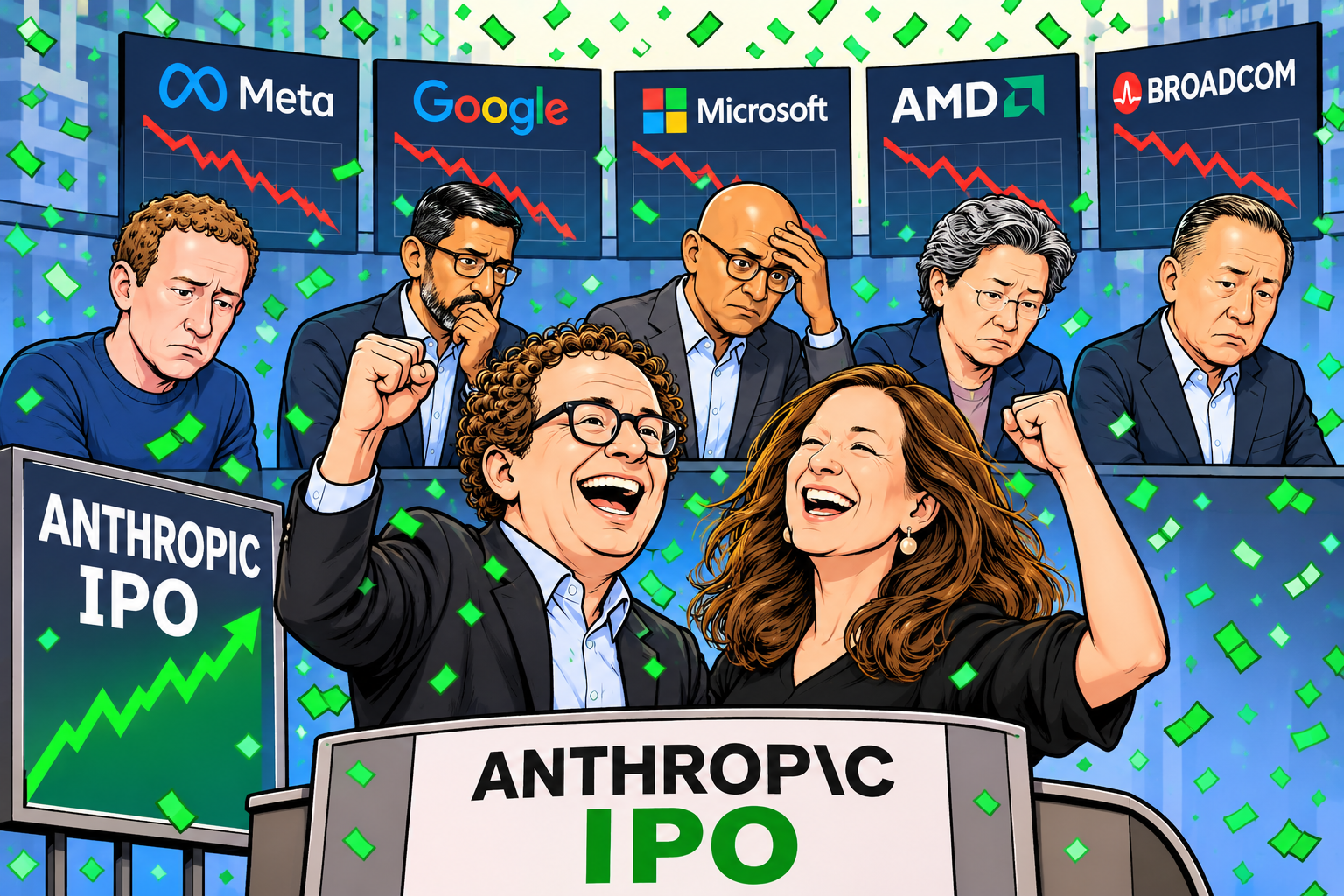
Anthropic’s first day as a public company delivered a 17% share price gain, but the broader market quickly put that debut in a harsher context. By Friday, the Nasdaq had fallen 5.6%, and reports put the week’s losses across AI-related shares at $4 trillion. For technology leaders, the signal is less about one new stock than about how quickly enthusiasm for AI spending can turn into concern over returns, costs and market exposure.
The offering appears to have landed in a middle ground: the opening gain was large enough to mark a strong debut without suggesting that the company had priced its shares far below what buyers would pay. Anthropic now has more than $90 billion in its bank account, giving it substantial resources even if its shares prove volatile. That volatility is already visible: the stock fell 9% on Friday after its first day of trading.
The broader selloff reached companies across the technology sector, including Google, Microsoft, Meta, AMD, Broadcom and Nvidia. Concerns about AI investment and its prospects were part of the pressure, alongside the prospect of an interest-rate increase. Asian markets also fell. A strong debut by a high-profile AI company, then, did little to reassure investors about the sector’s near-term direction.
OpenAI is now the next company to watch. It is reportedly planning to go public sometime next year, and Anthropic’s market debut offers an early test of how public markets might value another large AI model maker. The reception could depend not just on demand for AI, but on whether companies can show that substantial spending on models and infrastructure will produce durable business results.
Nvidia keeps operating through a leadership change
Nvidia reported better-than-expected earnings, but the results did little to lift its share price amid the wider decline. Interim CEO Colette Kress struck a bullish tone on the company’s earnings call. The results and her comments suggest the business remains on a strong footing for now, even after former CEO Jensen Huang’s resignation.
Huang has said he is open to returning. Yet the company’s board appears set against that outcome, and reporting has described board concerns about his conduct before his departure. For customers and technology teams, the immediate operational question is whether Nvidia’s product and business plans continue without disruption. The latest earnings call offered some reassurance on that point, though the company’s share price remains exposed to the same market doubts weighing on other AI names.
Outages put reliability under scrutiny
A run of service disruptions has prompted questions about whether AI is contributing to weaker reliability. The available explanations don’t point to one common cause, and cyberattacks do not appear to account for the incidents as a group. One possibility is that older systems and dependencies are struggling to keep pace with faster development and deployment cycles.
There’s also a risk on the remediation side: AI-assisted work to identify and fix software vulnerabilities can move quickly, but changes made at speed can introduce new faults. That possibility deserves attention from teams changing their development or incident response practices, but it does not establish a single cause for the outages. The practical takeaway is to examine the specific systems, changes and dependencies involved in each incident rather than assume that a shared timing means a shared failure mechanism.
The distinction between reliability and resilience matters here. Reliability concerns whether systems work as expected; resilience concerns how well they withstand and recover from disruption. Recent outages have renewed interest in both questions, particularly as organizations connect more services and accelerate software changes. Reporting on the recent outages and a separate look at resilience examine the technical issues and the limits of treating uptime as the whole measure of service health.
Security providers prepare for more AI-related demand
Security companies are expanding through acquisitions as AI changes both the tools defenders can use and the pace of potential attacks. Palo Alto Networks agreed to buy AI startup Applied Compute for $4.5 billion, adding another large deal to a series of acquisitions by the company. CrowdStrike was also reported to be in talks to acquire Zscaler, itself an active buyer. The reported discussions were not presented as a completed deal.
The moves reflect a market in which providers are trying to add products and capabilities quickly. They also leave IT buyers with practical questions: whether tools will be integrated, how product road maps may change, and what happens to existing contracts and support arrangements. The reports do not provide answers to those customer-specific questions, so teams evaluating either vendor should watch for details from the companies before changing plans.
Other security developments point to the challenge of managing AI agents and automated changes. Companies announced tools for supervising agents, tracking them in cloud environments and managing identity risks. One report described a compromise involving a Microsoft Agent Framework package and a release pipeline certificate; another said Google found an AI framework had turned security patches into exploitable issues without a person involved in the process. Those claims underline why organizations should review how automated tools access code, approve changes and reach production systems.
Funding and product launches keep the AI pipeline busy
The public market’s retreat has not stopped private investment or product development. This week’s reported funding included $5 billion for Alphabet’s Isomorphic Labs, which is working on AI-driven drug discovery; $250 million for Model ML at a $1.5 billion valuation; and $110 million each for Noeri and medical AI startup Boltz. Other rounds included $90 million for Linq, $57.5 million for LanceDB, $47 million for Humyn Labs and $35 million for Knit Health. Smaller raises included $30 million for Remanence, $7.5 million for Unsiloed and $5.3 million for Tesorai.
The range of companies is notable: they are applying AI to finance, biological research, robotics, patient referrals, model training and the conversion of scanned documents into structured data. That breadth suggests companies are still funding specialized infrastructure and applications, even as public investors question the scale and payoff of AI spending. Funding totals alone do not establish whether these businesses will find lasting demand; for enterprise buyers, the useful signal will be whether products solve a defined workflow problem and fit existing systems.
Model releases and platform updates continued as well. OpenAI rolled out GPT-6.2 Astra for professional work and GPT-6.2 Sol for everyday tasks. Google updated Gemini’s agentic Task mode, added computer-use capabilities to its Mac app and introduced Gemini 4 Neon, described as three times faster than Carbon and ahead on some metrics. Alibaba launched Qwen4-Max with training and attention optimizations, while Reson8 made its Rumble-2-Flash speech model available as a free open-weights download.
For infrastructure teams, other developments included Nvidia’s Rubin high-performance computing chip and scientific research libraries, and Arista’s work on distributed inference networking. Microsoft introduced first-party models and agent updates, while Red Hat and Microsoft brought OpenShift virtual machines to Azure. These announcements point to continued investment across compute, networking, cloud and software layers, even as spending concerns weigh on listed technology companies.
What technology teams should watch next
Next week’s significant earnings reports include Dell, HP, Nutanix, Workday and Zoom. After Thanksgiving, AWS re:Invent runs Nov. 30-Dec. 4 in Las Vegas, where another wave of cloud announcements is expected. IT leaders assessing AI plans will have fresh financial results and product details to weigh against the current market volatility.
Anthropic’s debut has not settled the question of whether AI shares have further room to run. It has made the uncertainty harder to ignore: a company can raise more than $90 billion and post a strong first trading day while the rest of the sector falls sharply. For administrators and IT managers, the near-term task is to follow vendor road maps, check the business case behind planned AI spend, and keep reliability and change controls in view as new systems reach production.
===

