Five Security and AI Tools MSPs Can Add to Their Service Portfolio
Five vendors offer MSPs ways to secure email and identities, manage AI use, automate training and make operational documentation easier to trust.
AI is adding new work for managed service providers: they need to help customers use it while protecting the accounts, information and processes those tools can reach. Five vendors are addressing different parts of that problem, from email threats and identity controls to AI oversight, staff training and documentation. For MSPs, the practical question is how each product fits existing service delivery and customer workflows.

Protect email and identity as access expands
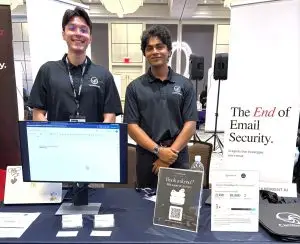
Collin Togher and Armaan Chakrabarti
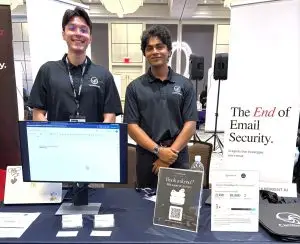
Cambrient AI focuses on email security for both employees and AI agents. Its system examines suspicious messages and follows links beyond the initial email, aiming to find phishing pages that sit several clicks into a chain. That matters as agents gain access to inboxes, documents and business applications: a message can become a route to influence what an agent reads or does.
The company also presents plain-English explanations of flagged messages in users’ inboxes. That may help customers understand why a message was marked and reduce the support burden associated with security alerts. CEO and co-founder Armaan Chakrabarti said Cambrient uses AI agents to inspect links that conventional filters may miss, including links buried two or three clicks beyond an email. He described the product as built for newer threats involving trusted applications and AI workflows.

Robert Sharp (second from right)
HENNGE addresses account security and application access for small and midsize businesses. Its HENNGE Identity platform includes conditional access and is delivered through MSP partners. The company positions it as an additional identity layer beyond passwords and multi-factor authentication.
HENNGE entered the U.S. market in 2025, backed by a Japanese cybersecurity provider, and says it has been adapting its service to MSP needs. Partner feedback led to multitenant capabilities, and the company established an MSP advisory board to guide development. Its channel-only model has no minimum commitments or onboarding charges, according to the company; partners can also stop billing when a customer leaves. President and CEO Robert Sharp described the U.S. approach as focused on predictable growth and long-term partner relationships.
Give customers a managed path to AI

Kelcye Blankenship-Lackland (right)
Hatz AI offers a managed AI platform that gives MSPs more visibility into customer use. It is also intended to help providers create recurring revenue from AI services. That opportunity is tied to a common operational concern: employees may already be using AI tools without the business having a clear view of where information is going or who is paying for the service.
The company’s Hatz Activate feature connects to an MSP’s professional services automation (PSA) system. It uses customer information to produce shadow AI risk assessments and draft proposals with use cases for the customer’s industry. Hatz says the process can be completed in less than a minute. Director of channel enablement Kelcye Blankenship-Lackland said the platform is designed to give MSPs a way to offer a secure, managed AI service and keep customer conversations focused on data handling, oversight and business use.
Reduce the work behind security training

Phin Security helps MSPs manage security awareness training.
Phin Security provides security awareness training, phishing analysis and dark web monitoring through an MSP-only model. Its platform is built to help providers manage security education across multiple customers without repeating the same administrative setup for every organization.
One feature lets an MSP create a shared training campaign for several clients, instead of configuring separate programs for each one. The company is also focusing on automation and simpler campaign management as providers add customers. Phin identifies AI-generated deepfakes and phishing as awareness challenges for a broad range of technology users. Head of marketing Kelsey Purcell pointed to the financial harm a phishing email can cause and argued that security knowledge should extend beyond people who work directly in cybersecurity.
Make operational knowledge usable by people and agents

Pinar Ormeci
Lexful organizes MSP procedures, customer records and technical documentation into a structured knowledge system that technicians and AI agents can query. The aim is to make reliable information easier to find than it is across disconnected files, while giving AI workflows traceable source material.
MSPs can use the platform to review documentation, spot outdated or missing records, and prepare for customer reviews or compliance work. Lexful announced general availability in August and expanded integrations with PSA and remote monitoring and management (RMM) platforms. It can also migrate existing documentation and help providers plan how to close gaps. CEO Pinar Ormeci said the product is designed as a system of record, with sources and guardrails to help people and agents reach relevant information while reducing unsupported AI output.
Together, the five products address separate parts of MSP operations: email inspection, identity protection, managed AI, security education and documentation quality. Providers assessing them should map each capability to existing customer needs and workflows, then check how it connects with their current tools and service model.


