Microsoft Copilot Home, Cowork and Code: What USL and UBB Mean for IT Teams
Copilot’s new Home and Code tabs bring different billing models together. Chat uses USL; Cowork and Code use Copilot Credits under UBB.
Microsoft Copilot’s new Home and Code tabs make its experiences easier to find, but they also put different billing models close together. For administrators, the key distinction is that Chat is covered by a User Subscription License (USL), while Cowork and Code use Usage-Based Billing (UBB) and Copilot Credits.
That distinction affects how organizations should assess access and spending. Seeing Cowork or Code in the interface doesn’t by itself mean the work is included in an existing subscription. Microsoft’s documentation says UBB experiences require a USL for access and consume Copilot Credits.
Home combines Chat and Cowork
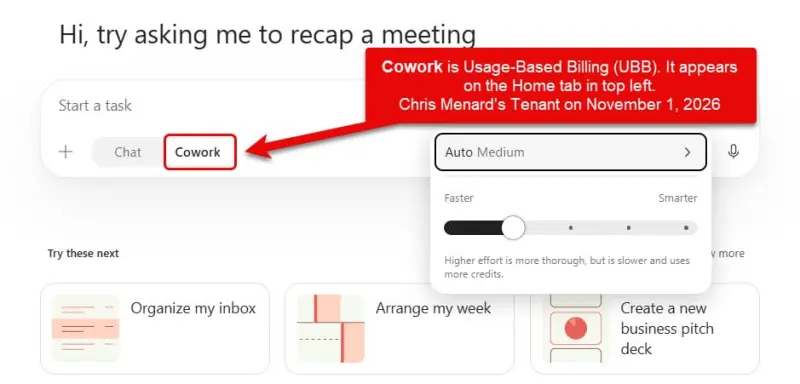
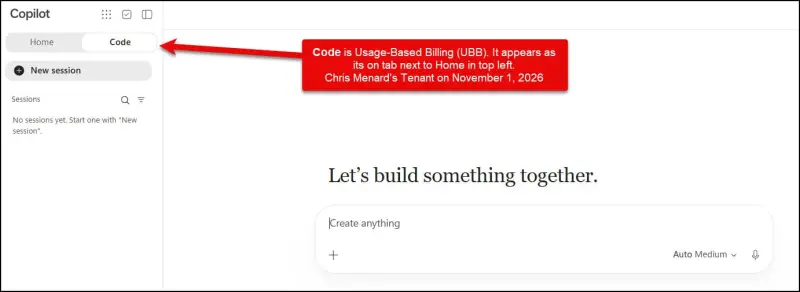
The updated Copilot interface shown in a tenant on November 1, 2026, has two main tabs in the upper-left corner: Home and Code. Home brings together Chat and Cowork, while Code has a separate tab. Microsoft describes Home as the entry point for Chat and Cowork, and Code as a way to build software from natural-language descriptions. Microsoft’s description of the new Copilot experience and its Code overview explain those capabilities.
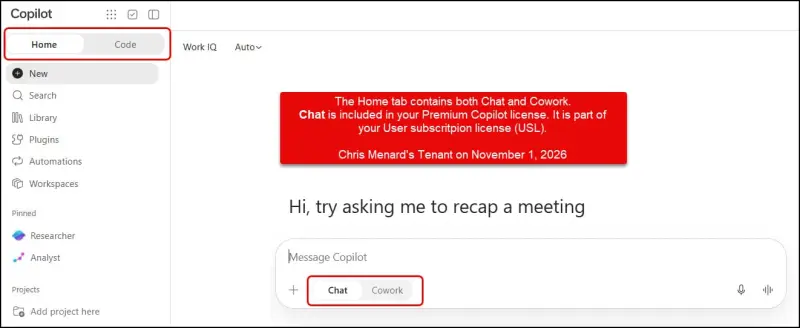
The layout puts Chat and Cowork together, but the two experiences don’t share a billing model. Chat sits within USL. Cowork is classed as UBB. Administrators and trainers should keep that difference clear when explaining what users can access and how usage may be funded.
USL covers everyday Copilot work
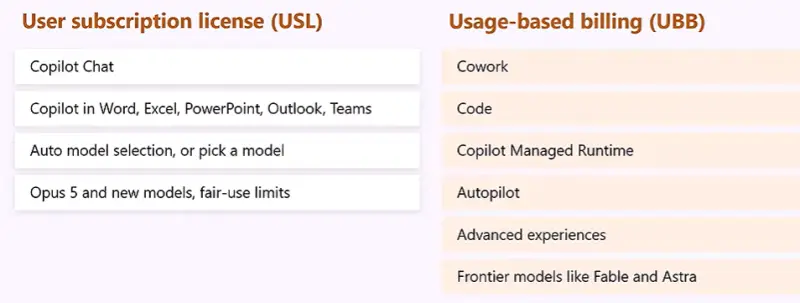
USL means User Subscription License. Microsoft presents it as the fixed-price basis for everyday AI tasks, including summarizing meetings, drafting documents and performing analysis. The description also includes Auto model selection and access to certain models, subject to applicable limits.
For the experiences described here, the practical shorthand is Copilot Chat = USL. That gives teams a useful starting point when they review which Copilot activities fall within their subscription. Model access and usage remain subject to Microsoft’s applicable limits, so administrators should check the terms that apply to their users rather than assume every model or workload is included.
UBB applies to Cowork and Code
UBB means Usage-Based Billing. Microsoft describes it as the model for advanced AI and agentic work that can call for more time, computing resources or specialized frontier models. Eligible UBB services consume Copilot Credits.
Cowork is available from inside Home, which can make it look like another mode of the everyday Chat experience. Its billing classification is different: Microsoft places Cowork under UBB. The interface location tells users where to find it; it doesn’t establish that its usage is included in the same subscription as Chat.
Code is separated into its own tab. Microsoft describes it as a way to request working software in natural language, including apps, dashboards, internal tools, static websites, data transformations, automations and scripts. Microsoft classifies Code as a UBB service; access requires a Copilot license, and usage consumes Copilot Credits.
The documentation also identifies Copilot Managed Runtime and advanced work in SharePoint and OneDrive among supported experiences that may use UBB. The billing model therefore extends beyond the two capabilities that are most visible in this interface.
What administrators should check
Organizations using supported UBB services need to consider how those services will be funded and how spending will be controlled. Microsoft describes billing options that include pay-as-you-go and other Copilot Credit purchasing arrangements. The available setup depends on the service and the organization’s chosen billing approach.
Microsoft provides Cost Management in the Microsoft 365 admin center for configuring usage-based billing, spending policies, limits and alerts. Administrators can use those controls to set boundaries for supported UBB services. Before making Cowork or Code broadly available, teams should confirm the relevant billing setup and spending controls, then make the distinction between subscription access and credit-consuming usage clear to users.
A quick classification for planning is:
- USL: Copilot Chat, everyday productivity scenarios, Auto model selection and certain model access, subject to applicable limits.
- UBB: Cowork, Code and other supported advanced or agentic experiences. Usage consumes Copilot Credits.
Expect tenant differences during rollout
The interface described here was visible in one Microsoft Copilot tenant on November 1, 2026. Microsoft is actively developing and rolling out these experiences, so the tabs and available capabilities may differ between tenants. Administrators should check what their users can access and review the applicable billing configuration as the new layout appears in their environment.
The main operational takeaway is straightforward: Chat is associated with USL; Cowork and Code are associated with UBB. Treat the Home tab as a place that groups distinct experiences, not as a signal that they all draw from the same subscription allowance. Before users move into Cowork or Code, make sure the organization has an appropriate UBB setup and understands how Copilot Credits will be controlled.


