ConnectWise’s Four AI Priorities for MSPs: Standardize, Start Small and Measure Results
ConnectWise executives urge MSPs to standardize tools, test one task safely and use AI gains to improve service and show customer value.

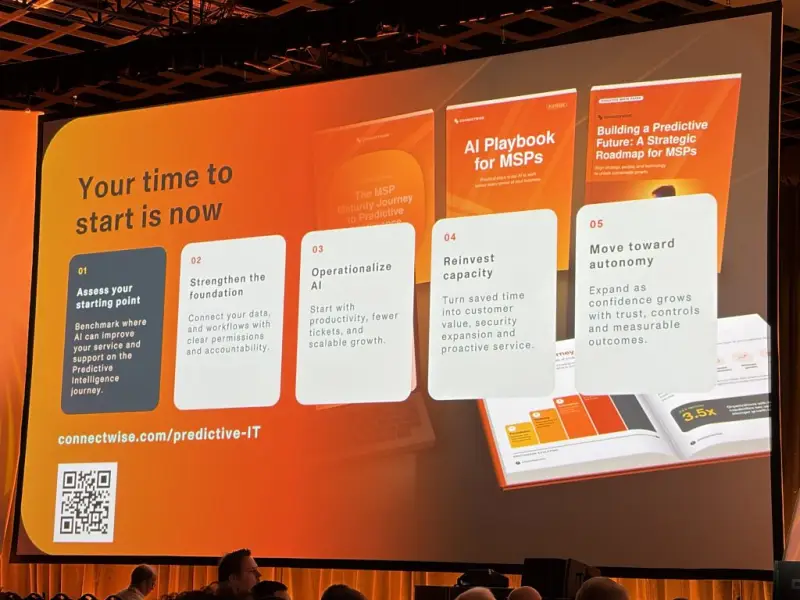
For managed service providers, AI’s value will depend less on how many tools they adopt than on whether automation frees technicians to solve customer problems. ConnectWise CEO Manny Rivelo and Chief Product and Technology Officer David Raissipour outlined four practical priorities for MSPs at IT Nation Connect Global 2026: standardize the technology stack, begin with a repetitive task, plan for governance and turn saved time into better service.

The advice addresses a common operational challenge: choosing among new AI products while keeping systems connected and customer work under control. ConnectWise’s approach is to place AI capabilities within the platform MSPs already use, with the stated aim of reducing repetitive work and making it easier to expand services without adding staff at the same pace.
Build a usable foundation
Rivelo recommends first reviewing the tools that run the business and simplifying the stack where possible. A more consistent set of systems can make it easier to connect data, automate workflows and apply AI across operations. He described the goal as having common data, a reasoning engine and a system of record.

That foundation matters because automation depends on access to relevant information and predictable processes. If data is scattered across disconnected products, an MSP may need to do extra integration work before an agent can handle a task reliably.
ConnectWise is embedding agentic capabilities into its platform rather than treating automation as a separate product. The company also plans to let partners build agents for their own business needs using its agentic framework, which includes integrations, monitoring and governance controls. For MSPs weighing custom development, those platform capabilities could shape how much work they need to maintain themselves.

Choose one task and test it first
MSPs don’t need to automate an entire service operation to start learning. Rivelo advises selecting one recurring activity that takes up meaningful technician time. Credential resets are one example: automating that work could reduce ticket volume and leave staff with more time for complex customer issues.
A limited first project also gives a team a practical way to learn how AI behaves in its environment. Rivelo sees early automation as a chance to build confidence and help staff adapt to new ways of working.
ConnectWise’s Agent Lab offers customers using its platform a selection of prebuilt agents trained for their environments. MSPs can assess proposed actions in “shadow mode,” where an agent shows what it would do without carrying out the action. Technicians can review those decisions and choose which tasks to authorize. After they’re satisfied with performance, they can disable shadow mode and allow the agent to act more independently.
That staged process gives teams a way to gather experience before granting an agent more authority. It also makes review part of deployment: technicians can compare proposed actions with their expectations and decide whether the automation is ready for live work.

Plan for governance and upkeep
Raissipour cautions MSPs against building an agent for every problem simply because the tools make experimentation easier. Creating an automation is only one part of operating it. Security, governance, monitoring, maintenance and the ability to scale all need attention.
He warned that custom agents built quickly may lack the infrastructure needed to support them over time, creating risks for providers and their customers. His advice is to define the business outcome first, decide how to measure success, and then select a technology that can deliver it. Building a solution internally may not be the best use of an MSP’s time or resources.
ConnectWise’s framework is intended to give partners a basis for developing automations while relying on platform capabilities underneath. For MSPs considering that route, the key question is whether the framework and its controls fit the task they want to automate, including its ongoing monitoring and support needs.
Use efficiency to improve customer outcomes
AI’s operational gains don’t have to translate into fewer technicians or lower prices. Raissipour argues that providers can redirect staff toward work that calls for judgment, creativity and a stronger understanding of customer needs. The aim, in his framing, is to free people to tackle problems automation can’t handle and deliver more value.
That could mean faster responses, stronger service-level agreements or preventing an issue before a customer notices it. ConnectWise’s Rivelo also suggested that better results could eventually influence how MSPs price services. If a provider can reduce a customer’s monthly tickets from 50 or 100 to five, he asked, would the customer pay more for that outcome?
Such a shift would put less emphasis on endpoint counts or ticket volume alone and more on service quality and avoided disruption. Ann Westerheim, founder and president of Greater Boston-area MSP Ekaru, said ConnectWise is pursuing AI capabilities across PSA assistants, intelligent ticket intake and agents for tasks such as dispatch. She described the opportunity as clear, while emphasizing that MSPs still need to turn the promise into measurable results.
Measure before expanding
Rivelo and Raissipour’s closing guidance is to experiment now, while keeping the first step manageable: identify a recurring problem, assess whether automation can address it and measure what changes. A successful trial can give an MSP evidence and experience to decide whether to extend AI to more complex work.
The useful measure isn’t simply how many tickets a team processes with fewer people. MSPs should look at whether routine work takes less time and whether the freed capacity improves customer service. That gives providers a clearer basis for judging AI’s business value and deciding what to automate next.


